Introduction to Hardware Oriented Deep Learning Training
About the Training
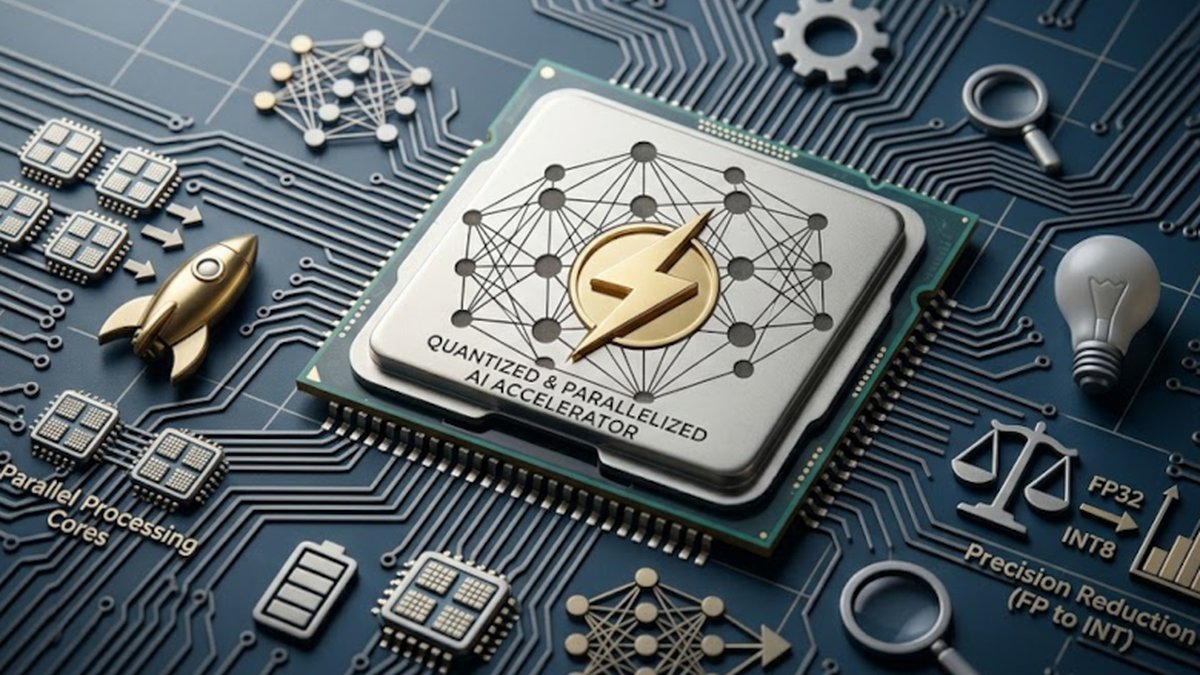
The primary goal of this training is to bridge the gap between software and hardware by focusing not only on the algorithmic success of deep learning models, but also on their operational efficiency in the physical world. As AI models reach enormous sizes today, computational costs and energy consumption have become major obstacles; therefore, participants are expected to gain the competence to optimize their models according to the target hardware architecture (GPU, TPU, Edge devices), manage memory bottlenecks, and strategically utilize modern parallel processing techniques (Data/Model Parallelism). In short, the training aims to provide a "hardware-aware" engineering vision that will take a theoretical model from the lab environment and run it with maximum performance on real-world systems.
Course Objectives
A participant who successfully completes this training will:
Recognize Hardware Architectures: Explain the fundamental roles and architectural differences of different hardware components such as CPU, GPU, TPU, and FPGA in deep learning processes.
Identify Performance Bottlenecks: Understand why training and inference slow down in deep learning models; It analyzes within the framework of computing power (compute-bound) and memory bandwidth (memory-bound) constraints.
Understands Memory Hierarchy: Understands the cost of moving data between memory layers (LI/L2 Cache, HBM, DRAM) and its impact on total training time.
Distinguishes Model Compression Methods: Understands in which situations and with which hardware techniques such as pruning, quantization, and knowledge distillation provide advantages.
Evaluates Accuracy Strategies: Interprets the effects (trade-offs) of data types such as FP32, FP16, BF16, and INT8 on model accuracy and hardware efficiency.
Understands Parallelization Concepts: Understands the basic working principles of Data, Model, Pipeline, and Tensor parallelization strategies and when to prefer them.
Course Content
Section | Topic Title | Duration | Description and Subtopics |
Introduction | Introduction to Deep Learning Fundamentals | 4 Hours | Architectures and Training Mechanisms: History of deep learning, MLP, CNN, and Transformer architectures. Backpropagation, gradient descent, activation functions, and fundamental layer structures (Linear, Conv, Norm). |
Part I | Why Does Hardware Matter? | 2 Hours | Performance Analysis: Training and inference bottlenecks. FLOPs calculations, latency, throughput, and energy-efficiency metrics. Roofline model: Compute-bound vs. memory-bound performance. |
Part II | Hardware and Memory Hierarchy | 2 Hours | Architectural Differences: Comparison of CPUs, GPUs, TPUs, and FPGAs. Data movement costs, memory hierarchy (Cache, DRAM, HBM), and numerical precision (FP32, FP16, INT8). |
Part III | Model-Level Optimization | 3 Hours | Compression Techniques: Model pruning, sparsity, quantization methods, and knowledge distillation. Hardware-friendly efficient architectures. |
Part IV | System-Level Optimization | 3 Hours | Parallelization Strategies: Data, model, pipeline, and tensor parallelism. Automatic mixed-precision training (AMP) and communication protocols such as NCCL/MPI. |
Part V | HPC and Scaling | 2 Hours | Large-Scale Systems: High-performance computing (HPC) environments, an introduction to the DeepSpeed library, the principles of ZeRO (Zero Redundancy Optimizer), and LLM scaling strategies. |
Final | Conclusion and Future | 1 Hour | Closing: Hardware-software co-design, future hardware trends, course summary, and Q&A session. |
Certification
Participants who meet the 70% attendance requirement and pass the exam at the end of the training will be entitled to receive a "Certificate of Achievement."
Participants who meet the 70% attendance requirement but do not pass the exam will be entitled to receive a "Certificate of Participation."
Application Requirements
This training targets researchers and professionals working in the artificial intelligence sector who have completed a bachelor's degree in technical fields such as computer science, software engineering, electrical and electronics engineering, or data science, and preferably are pursuing graduate studies. Participants are expected to have a strong understanding of fundamental deep learning concepts (neural networks, training cycles, optimization methods) and experience developing models with at least one deep learning library (PyTorch, TensorFlow, etc.). The training is designed for systems engineers, HPC (High-Performance Computing) specialists, and developers working in "Edge AI" fields who want to optimize their models not only at the software level but also by considering hardware constraints (memory, processing power, energy). While a basic understanding of computer architecture is advantageous, it is not a mandatory prerequisite; the training covers the theoretical foundations that will bridge these disciplines.
Instructors
Doç. Dr. Erdem Akagündüz
View Profile →Training Summary
If you are not registered, create an account now.
Purchasing for 15 or more people?
Request a Corporate Offer