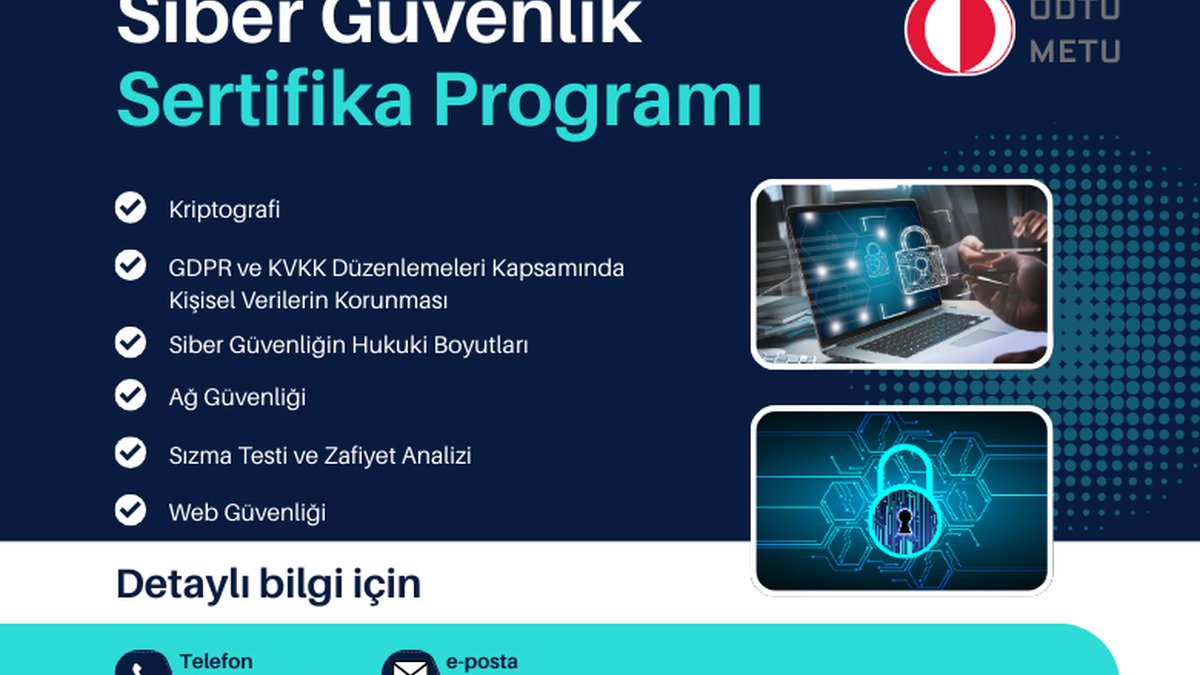
Cybersecurity Certificate Program
The primary goal of this training program is to equip participants with the technical knowledge and practical skills in cybersecurity, enabling them to design and manage secure systems and to detect and prevent potential threats.
About the Training
With the accelerating pace of digital transformation today, cybersecurity threats and risks have also increased significantly. Cyber threats faced by individuals, institutions, and governments globally are of paramount importance in terms of protecting critical data, information security, and legal compliance. In this context, the need to train individuals specializing in cybersecurity is growing day by day.
The aim of this training program is to teach participants the technical and legal aspects of cybersecurity, to equip them with the competence to design and support a secure network infrastructure, and to provide them with the knowledge and skills to conduct penetration testing and vulnerability analysis. Upon completion of this training, participants will have learned the fundamental principles of cybersecurity, existing threats, and solutions developed against them in detail, thus gaining professional competence in this field.
Course Objectives
The training objectives are defined as follows, in line with the four main modules covered within the program:
• Students will be able to apply secure data encryption methods using block and stream encryption techniques.
• Students will be able to evaluate the usage areas and security levels of cryptographic hash functions.
• Students will be able to analyze and apply verified encryption and lightweight cryptography methods.
• Students will be able to understand the basic principles of public key cryptography and solve/implement secure key management processes.
• Students will be able to identify how side-channel attacks occur and determine the points where precautions should be taken.
• Students will be able to evaluate post-quantum cryptography methods and their potential effects.
• Students will be able to understand how blockchain and cryptocurrency technologies work in terms of security and develop secure applications.
• Students will understand the legal framework for the protection of personal data under the General Data Protection Regulation (GDPR) and the Personal Data Protection Law (KVKK).
• Students will be able to understand how personal data is processed and protected in the digital world and create secure data management policies. • Students will be able to minimize risks by understanding the fundamental responsibilities and legal basis in data processing processes.
• They will have knowledge of explicit consent management, international data transfers, and the duties of a Data Protection Officer (DPO) under GDPR. They will be able to analyze personal data processing processes in technologies such as artificial intelligence, big data, and cloud computing.
• They will be able to develop security measures in accordance with the principles of privacy by design (Privacy by Default).
• They will have knowledge of cybercrimes, cybercrimes, and legal regulations related to these crimes.
• They will understand the definition of cybercrimes in the Turkish Penal Code and the possible sanctions.
• They will be able to analyze the types of crimes committed using information systems and the processes of obtaining evidence.
• They will be able to conduct security tests within the framework of ethical hacking by understanding the concept of white-hat hacking.
• They will have knowledge of penetration testing contracts and legal requirements.
• Cisco Networking Academy Cybersecurity and Network Security topics will be covered. • They will be able to implement necessary measures to secure corporate networks.
• They will be able to analyze network threats and develop appropriate security strategies.
• They will be able to manage access control, authentication, and authorization (Authentication, Authorization, Accounting (AAA)) processes. They will be able to implement firewall technologies, intrusion prevention systems (IPS), and Virtual Private Network (VPN) configurations. They will be able to enhance data security using endpoint security, integrity verification, and public-key cryptography.
• They will be able to detect and prevent threats by conducting network security tests.
• They will learn the differences between penetration testing and vulnerability analysis.
• By understanding the stages of penetration testing and different types of penetration testing, they will be able to analyze the general structure of the penetration testing process.
• They will be able to gather information about target systems using active and passive discovery techniques.
• They will be able to analyze system vulnerabilities using open-source tools. • They will be able to apply methods such as vulnerability exploitation, information gathering after exploitation, escalation of privileges, and establishing persistence in the system. • They will be able to develop defense strategies against attacks by applying methods such as social engineering and password attacks.
Course Content
The Cybersecurity Certificate Program consists of 6 main modules covering 75 hours. The modules that make up the program are as follows: Our training consists of 6 main modules, and the topics are shared below:
1. Cryptography (18 hours)
• Block ciphers
• Stream ciphers
• Cryptographic hash functions
• Verified encryption
• Lightweight cryptography
• Public key cryptography
• Side-channel attacks
• Post-quantum cryptography
• Blockchain and cryptocurrency technologies
2. Protection of Personal Data (Digital Privacy) under GDPR and KVKK Regulations (6 hours)
• Introduction: The Digital World and Personal Data
• What is the purpose of the legal regulations on this subject?
• Scope of GDPR and KVKK
• Opportunities and Threats under GDPR and KVKK
• Artificial Intelligence and Personal Data
• Basic Concepts of GDPR and KVKK
• Who is the Data Controller and Data Processor?
• Basic Checklist (GDPR and KVKK)
• Basic Responsibilities Regarding Data Protection
• GDPR Basic Principles of Data Processing and Legal Basis for Data Processing (Local Regulations)
• Explicit Consent (Conditions, Limitations, Procedure, Management)
• International Data Transfers under GDPR and KVKK
• Matters to be Included in Contracts under GDPR and KVKK
• GDPR Data Protection Officer (DPO) Powers and Responsibilities
• Rights of Data Subjects
• Privacy by Design (Privacy by Default)
• Special Data Processing Activities and Personal Data
(Cloud Computing, Internet of Things (IoT) - Internet, Big Data, Artificial Intelligence (AI)
3. Legal Aspects of Cybersecurity (3 hours)
• Concepts of cybercrime, cybercrime, and cybercrime
• Cybercrimes as defined in the Turkish Penal Code
• Fraud committed using information systems
• Crimes committed through information technology
• White Hat Hackers and cybercrimes
• Penetration Testing Contracts
• Obtaining evidence in cybercrimes
4. Network Security (30 Hours)
• Securing Networks
• Network Threats
• Mitigating Threats
• Secure Device Access
• Assigning Administrator Roles
• Device Monitoring and Management
• Authentication, Authorization, and Account Management (AAA)
• Access Control Lists (ACLs)
• Firewall Technologies
• Zone-Based Policy Firewalls
• Intrusion Prevention Systems (IPS) Technologies
• IPS Operation and Implementation
• Endpoint Security
• Layer 2 Security Considerations
• Cryptographic Services
• Basic Integrity and Accuracy
• Public Key Cryptography
• VPN
• Implementing Site-to-Site IPsec VPNs
• Introduction to ASA
• ASA Firewall Configuration
• Network Security Testing
• Final Implementation
5. Penetration Testing and Vulnerability Analysis (15 hours)
• Differences Between Penetration Testing and Vulnerability Analysis
• Types of Penetration Testing
• Stages of Penetration Testing
• Passive Discovery
• Active Discovery
• Bind Shell & Reverse Shell
• Using Metasploit Framework
• Vulnerability Exploitation
• Information Gathering After Exploitation
• Privilege Escalation
• Achieving System Persistence
• Social Engineering Methods
• Password Attacks
6. Web Security (3 hours)
• SQL Injection Attacks
• XSS (Cross-Site Scripting) Attacks
• CSRF (Cross-Site Request Forgery) Attacks
Certification
Each module has its own end-of-module exams and practical exercises.
Participants who meet the 80% attendance requirement and pass the exam at the end of the training will be entitled to receive a "Certificate."
Participants who meet the 80% attendance requirement but do not pass the exam will be entitled to receive a "Certificate of Participation."
Application Requirements
This training is aimed at undergraduate and graduate students, IT professionals working in the IT field, lawyers, system administrators, and anyone interested in cybersecurity.
Participants are expected to be familiar with the Linux environment, have basic terminal usage skills, and possess basic networking knowledge.
Instructors
Araş. Gör. Aslı Başak Civek
View Profile →Av. Fatih Öğmen
View Profile →Doç. Dr. Cihangir Tezcan
View Profile →Öğr. Gör. Dr. Orhan Aslan
View Profile →Doç. Dr. Pelin Angın Ülküer
View Profile →Prof. Dr. Ömer Delialioğlu
View Profile →Training Summary
If you are not registered, create an account now.
Purchasing for 15 or more people?
Request a Corporate Offer